Planning baby's first Christmas: traditions, keepsakes and a calm, safe day
We've done the research so you don't have to: how to plan baby's first Christmas, from simple traditions and keepsakes to a sensible budget, safe toys and a calm day that fits your baby's routine.
Dealizard may earn a commission when you buy through links on this page. It never changes the price you pay. Prices were checked on Amazon UK and Amazon US on 12 November 2026 and can change at any time.
We've done the research so you don't have to. A baby's first Christmas is a big day for the grown-ups, even though the baby won't remember it. It's easy to overspend, overbuy and pack the day with visits. This guide pulls together what parents and child-safety experts say is worth doing, worth buying and worth skipping, so the day stays calm, safe and fun.
We don't test products ourselves; we pull together what the experts and owners say. This is planning advice, not a ranked list. If you're choosing presents, our Christmas gift ideas for babies has seven toys we checked for price, ratings and stock in the UK and the US.
The short version
- Start two or three traditions you can repeat, such as a dated ornament, the same Christmas Eve book, or a photo in the same spot each year.
- Keep one or two keepsakes: a handprint or footprint, a short letter, or a first-Christmas box.
- Keep the present pile small. One toy, one book and one keepsake is plenty. Babies often prefer the wrapping paper.
- Plan the day around naps and feeds, not the other way around. Short visits usually go better than one long afternoon.
- Safety first: the right age label on toys, a baby-safe tree, a clear cot, and no loose button batteries or magnets.
What to expect
Your baby won't follow the plot of Christmas, but they will notice lights, music, new faces and the rustle of paper. How much they can join in depends on their age.
- Newborn to three months. They see best at close range, so they'll enjoy your face, your voice and a quiet look at the tree lights from your arms. Loud rooms and sudden noises can startle them. Presents won't mean much yet.
- Three to six months. They're starting to reach, grab and chew, and they like contrast, texture and gentle sound. A short spell on a play mat, a board book or a soft sensory toy fits this stage well.
- Six to 12 months. Many babies are sitting, crawling or pulling up, and some get wary of unfamiliar people. They may love a big box and hate being passed around. Watch for tired signs (ear-pulling, eye-rubbing, fussing) and build in a quiet break.
You don't need a packed programme. A few short, calm moments spread across the festive week usually work better than trying to do everything on Christmas Day.
Traditions worth starting
The traditions that last are the ones small enough to do again next year without a fuss. Pick two or three, not twelve.
- A dated ornament each year. Hang one with the year or a photo on it, and add another every Christmas. By the time they leave home, they'll have a set of their own. Hang it high, especially if it's glass or has small parts.
- The same book on Christmas Eve. Read one festive board book every year. Babies like hearing the same words again, and it gives you a calm end to the evening.
- One photo, same place, every year. Use the same chair, the same corner of the tree or the same pyjamas. The side-by-side pictures become the keepsake.
- A Christmas Eve box. Even a simple box with pyjamas and a book is enough this year. You can add more to it as they get older.
- A short lights walk. A brief evening stroll or a slow drive to see the lights is a break from a busy house. If you go by car, take bulky coats off before you buckle your baby in and use a blanket over the straps instead.
- A letter, a video call or a gift in their name. Write a few lines about the day and put the letter away; call relatives who can't visit (video calls with people they love are the usual exception to the advice against screen time for babies); or donate a toy or a food-bank item in your baby's name.
- A quiet hour at home. Set aside a stretch of Christmas Day with just your household: no visitors, no rushing, just a feed, a nap or a cuddle.
Matching family pyjamas, a first stocking and a festive outfit for the photos are popular too, as long as the clothes are comfortable, easy to change and free of loose bows, buttons or strings near the neck. Leave a visit to Santa until it suits you: some families love the photo; many babies that age are not keen on the lap of someone they don't know.
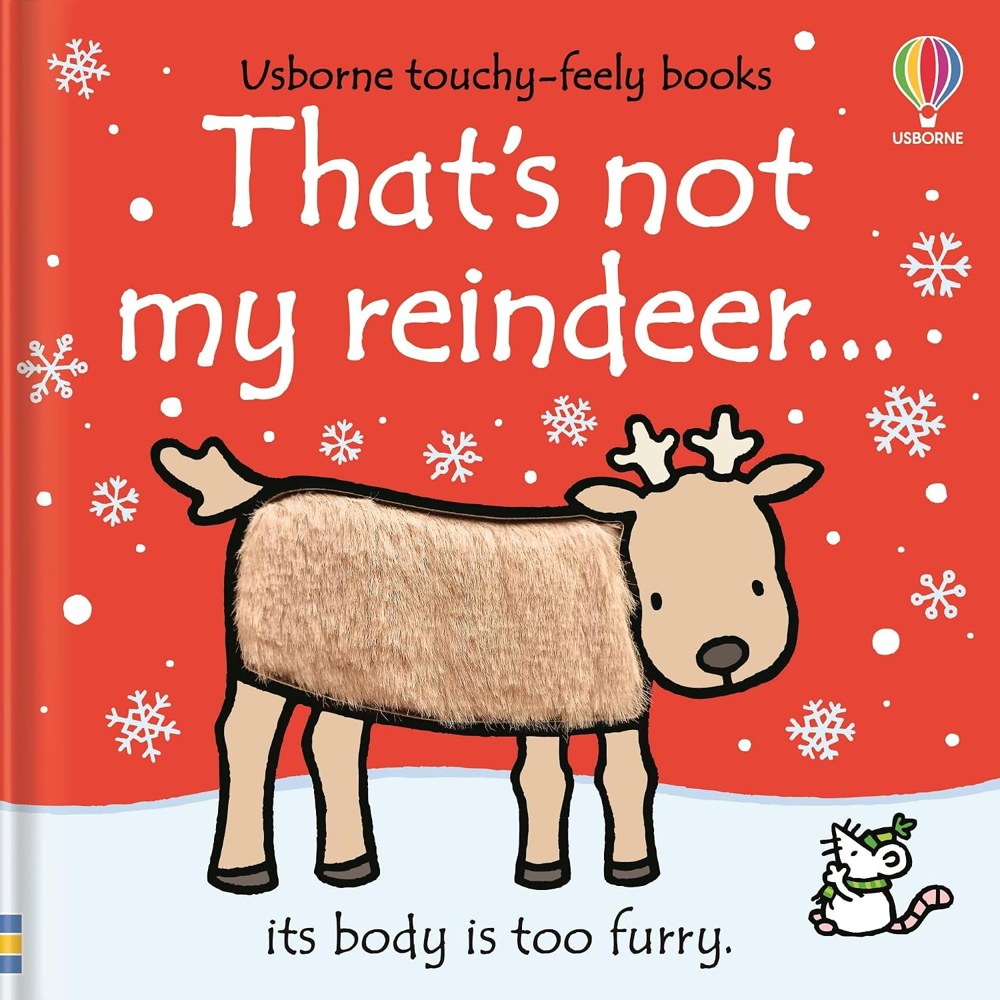
£4.48 on Amazon UK and $5.53 on Amazon US when we checked. See the latest price
A first Christmas Eve book: That's not my reindeer... is a touchy-feely board book with a textured patch on every page, made for babies and toddlers. It's rated 4.8 out of 5 on both Amazon UK and Amazon US. Board books are thick and wipeable, so they survive being chewed.
Worth knowing: the UK and US editions have different covers and product codes. Our link takes you to the right one for your country.
Keepsakes you'll still have in 20 years
The present you'll still have in 20 years is rarely the toy. Keepsakes can be small and cheap, and you only need one or two.
A dated first Christmas ornament
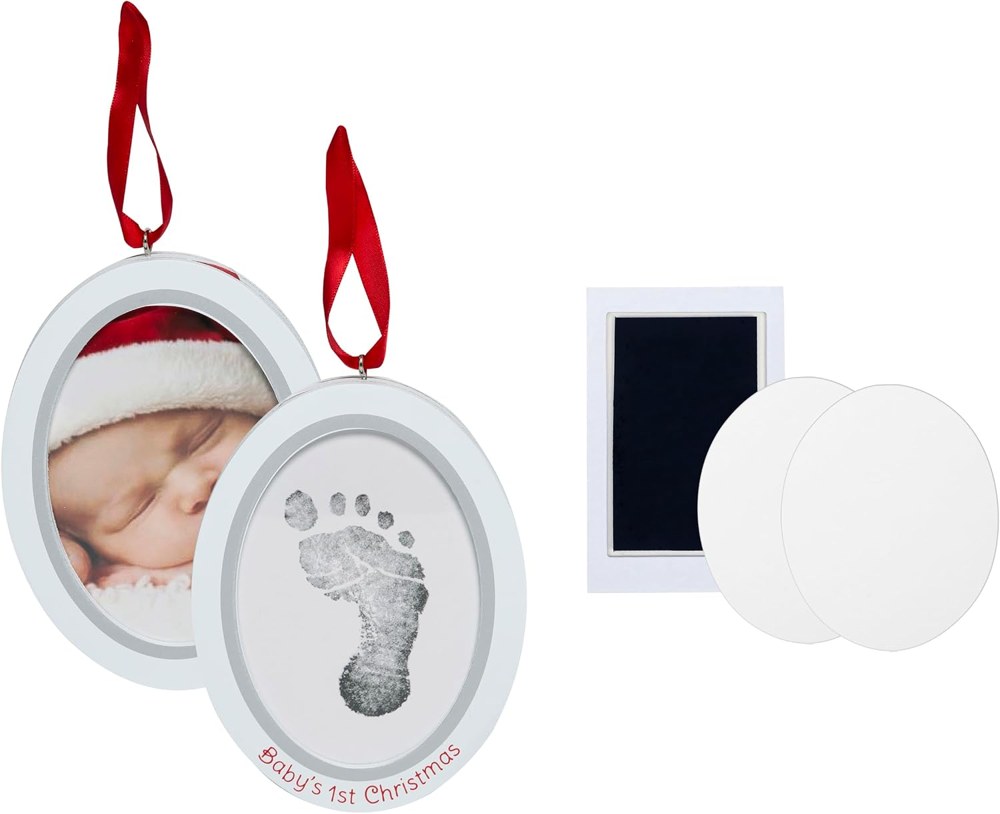
£9.06 on Amazon UK and $9.99 on Amazon US when we checked. See the latest price
What it is: the Pearhead Babyprints Double-Sided Christmas Photo Ornament, a round ornament with a photo on one side and your baby's handprint or footprint on the other. It's rated 4.7 out of 5 on Amazon UK and 4.6 on Amazon US.
Worth knowing: you make the print yourself with the kit, so do it on a calm day before Christmas, not on the day. Use the ink as directed and wipe hands and feet straight after.
A print, a letter and a first-Christmas box
- A handprint or footprint on a card, in the baby book or on the ornament. Use ink or paint labelled non-toxic, and wipe it off before it reaches a mouth.
- A letter to your baby. Write down where you spent the day, who visited and what your baby was doing. Seal it and add one every year.
- A first-Christmas box. Keep the card, a photo, a scrap of wrapping paper, the letter and, if you like, the outfit they wore. Open it together when they're older. Store anything small out of reach.
- A first stocking, if you want one. Hang it away from fires and heaters, and fill it with age-safe things such as a board book or a soft toy, not sweets, coins or small toys.
Gifts and a sensible budget
Babies don't need much, and they usually get a lot. Grandparents, aunts, uncles and friends often buy something too, so the pile grows quickly.
- Set a rough cap and stick to it. Something like £50 / $50 for your own presents is plenty for a baby under one. Most of the toys in our babies guide cost less than £25 / $25.
- Split it three ways: one toy they'll use for months, one book and one keepsake you'll keep for years.
- Tell family what you'd like. A short list stops five people buying the same rattle. Include clothing sizes (buy 3–6 or 6–12 months, not newborn: they grow out of the smallest sizes in weeks).
- Ask for a contribution instead. Many parents would rather have money put aside. UK: a Junior ISA or children's savings account. US: a 529 college savings plan or a children's savings account.
- Don't feel you have to buy the big stuff now. Play gyms, walkers and activity centres often work better as a birthday present, when your baby can use them straight away.
Two first-Christmas toys parents rate highly
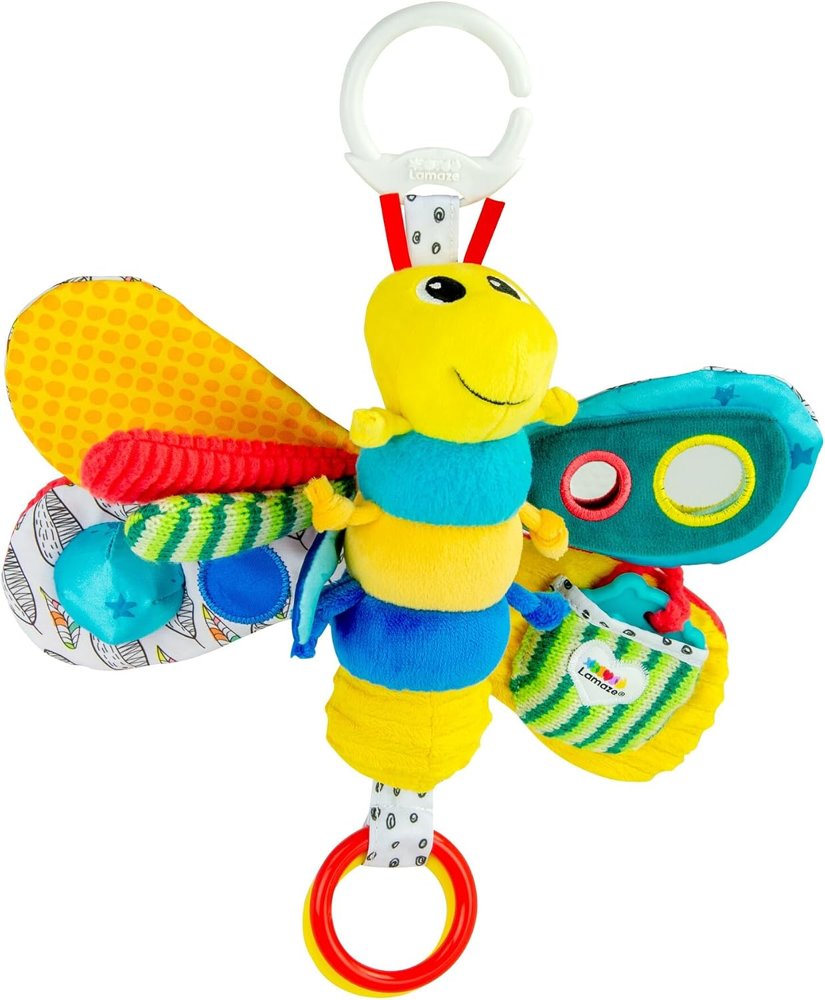
- Lamaze Freddie the Firefly, about £11 / $15. A soft clip-on sensory toy for the pram or car seat, from newborn, rated 4.8 out of 5 from more than 22,000 ratings on each site.
- Baby Einstein 4-in-1 Kickin' Tunes Play Gym, about £44 / $40. A play mat, toy arch and kick piano, from newborn. It needs 3 AA batteries, which aren't included.
More ideas, with ages and prices, are in our Christmas gift ideas for babies guide.
What not to buy
- Newborn-size clothes. Size up, and skip outfits with loose bows, buttons or strings near the neck.
- Sleep products that don't follow safe-sleep advice. UK and US guidance is the same: a clear cot with a firm, flat mattress. That means no cot bumpers, pillows, duvets, sleep positioners, pods, nests or weighted blankets, however good the reviews are.
- Soft toys for the cot. A teddy is a lovely present, but it belongs on a shelf or in the playroom, not in the cot, until your baby is at least 12 months old. The same goes for festive props in the cot, even for a photo.
- Sit-in baby walkers. Child-safety experts warn against the kind of walker a baby sits in on wheels, and they're banned in Canada. A push-along walker that your baby stands behind is a different thing.
- Toys marked 3+, even if they're "something to grow into". Put them away until they're old enough.
- Loud toys with no volume switch. Your baby will love them. You won't.
- Too much. One or two presents to open is plenty.
Planning a calm day
- Decide where you'll be. Some families keep Christmas Day at home and see relatives on Boxing Day (US: a day or two later). If you travel, pack the usual sleeping bag and a familiar toy for playtime, and check where your baby will sleep before you arrive. Take your own travel cot if you can, so you know the sleep space is right.
- Plan visits around naps. Tell family the times that work for you. Two short visits often go better than one long afternoon.
- Make a quiet room. A dimmer, quieter space for feeds and naps gives your baby a break from noise and being passed around. Older babies can get upset with unfamiliar people: it's fine to keep them close to you.
- Ask visitors to wash their hands, and ask anyone who is unwell to come another day. Winter bugs spread quickly, and a young baby doesn't need a queue of kisses on the face.
- Keep bedtime as close to normal as you can. A familiar routine helps your baby settle in a busy house.
- Don't try to do everything. It's fine to skip a gathering, leave early or spend the morning in pyjamas. If sleep goes off-track, go back to your usual routine the next day.
Keeping the day safe
- Secure the tree so it can't be pulled over, or put a baby gate around it. Keep it away from radiators, fires and heaters. If you have a real tree, keep the stand filled with water.
- Keep the bottom third of the tree baby-safe. No glass baubles, hooks, tinsel or anything that looks like a sweet. Felt, wood and shatterproof decorations only. Hide light cords, and unplug lights when you leave the room or go to bed.
- Clear wrapping paper, ribbons, bows and packaging as presents are opened. They're a choking and suffocation risk, and ribbons can get tight around a neck.
- Keep holly and mistletoe out of reach. The berries are poisonous. Poinsettias aren't poisonous but can cause an upset stomach if chewed. If you think your baby has swallowed part of a plant, get medical advice straight away. US aside: you can call Poison Control on 1-800-222-1222.
- Watch the table. Keep hot drinks and plates away from the edge. Whole nuts, popcorn, hard sweets and candy canes are a choking risk. Babies under 12 months shouldn't have honey, including in baked goods, and they shouldn't be given leftover alcohol from glasses.
- Ask visitors to keep bags up high. Handbags often hold medicines, coins and batteries.
- Never leave candles unattended, and use a fireguard that fastens to the wall if you have an open fire.
Safe toys: what to check
Age labels on toys are about safety, not just skill. A toy marked 3+ usually has small parts that a baby could choke on, however advanced your baby is.
- Check the age label. Choose toys marked from birth (0+) or for your baby's age, never "3+" or "not suitable for children under 36 months".
- Do the toilet-roll test. If a toy, or any part that could come off, fits inside a toilet-roll tube, it's too small for a baby.
- Look for a secure battery compartment. Button batteries can cause severe internal burns within hours if swallowed. Toys should have compartments that need a screwdriver to open. Keep spare batteries locked away. If you think your baby has swallowed one, go to A&E (US: the emergency room) straight away, even if they seem fine.
- Avoid loose magnets and toys with small magnetic pieces. Swallowed magnets can stick together inside the gut.
- Check soft toys for eyes, buttons and ribbons that could be pulled off. Embroidered features are safer than buttons.
- Keep older children's presents separate. Their building bricks, craft kits and toy cars are a choking risk for a crawling baby.
UK aside: toys sold in Great Britain must carry a CE or UKCA mark. Toys that aren't safe for under-3s must say "Not suitable for children under 36 months" or show the 0–3 warning symbol with the reason, such as small parts.
US aside: toys for children under 3 must meet the CPSC small-parts rule (nothing that fits in a test cylinder 1.25 inches / 31.7 mm wide) and the ASTM F963 toy safety standard. Toys with small parts for older children carry a "Choking hazard: small parts" warning.
Buy from sellers you trust. Cheap copies of well-known toys on marketplaces don't always meet safety standards. Our picks are sold by Amazon itself in both the UK and the US.
When to buy
Black Friday is Friday 27 November and Cyber Monday is Monday 30 November. Popular baby toys are often discounted before then, and the best-known ones can sell out or go up in price in December. Order keepsakes such as personalised ornaments early, as they can take longer to arrive.
To check if a price is really a deal, paste the product link into the Dealizard Deal Checker. It checks the price history and tells you if the price is Bad, OK, Good or Great. More in Is it a real deal? Meet the Dealizard Deal Checker.
FAQs
Will my baby remember their first Christmas?
No. A baby under one won't remember the day. The photos, the ornament and the traditions you start are really for you, and for them to look back on later. That's a good reason to keep the day simple rather than expensive.
Do babies need Christmas presents?
Not really. They'll often play with the wrapping paper more than what's inside. Presents are more for the family, so keep them few and choose things that will still be used after Christmas: a book, a keepsake, or one age-right toy. If you're looking for ideas, see our Christmas gift ideas for babies.
How much should I spend on a baby's first Christmas?
Whatever feels comfortable. Many parents keep it to one toy, one book and one keepsake, which can easily come in under £50 / $50. If family want to give more, a contribution to a savings account is a popular option.
What traditions should I start for a baby's first Christmas?
Choose two or three you can repeat without much effort: a dated ornament, the same Christmas Eve book, a photo in the same spot, a short letter, or a lights walk. Matching pyjamas and a first stocking are nice extras if you want them. You can always add more traditions next year.
What should I put in a baby's first Christmas stocking?
Age-safe, useful things: a board book, a soft toy or teether, a pair of socks in the next size up. Hang the stocking away from fires and heaters, and skip sweets, coins, small toys and anything with a button battery.
Can my baby sleep with their new teddy?
Not yet. UK and US safe-sleep advice is to keep soft toys, pillows, loose blankets and festive props out of the cot for at least the first 12 months. For sleep, use a normal sleepsuit or sleeping bag, without loose bows or strings. Keep the teddy for playtime.
Is it OK to take a baby to see the Christmas lights, or to a gathering?
Yes, for most babies, as long as you keep it short and follow their cues. Dress them for the weather, take bulky coats off before they go in the car seat, and head home if they get cold, hungry or overtired. For gatherings, plan around naps, keep a quiet room for feeds, and it's fine to leave early.
What's a safe first Christmas toy?
Something labelled from birth or for your baby's age, with no small parts, loose magnets or easy-to-open battery compartments. Soft sensory toys, play gyms, board books and chunky blocks are popular choices. Check the age mark, and buy from a seller you trust.